Newsletter Subscribe
Enter your email address below and subscribe to our newsletter

 ByJohn A
Unlike hyaluronic acid injections, serums only work on the outer layer (stratum corneum) or upper epidermis. They are a better option than serums for deep wrinkles as they bypass the skin barrier to restore lost structure volume physically from within.
Key Takeaways
Hyaluronic acid is a proven hero composition in skincare. People spend hundreds of dollars on HA serums while ending up experiencing that their deepest facial creases like nasolabial folds or marionette lines refuse to budge. This raises a confusion as to why a daily HA serum cannot smooth out deep wrinkles but injections can. Well, this is understood from the difference between surface hydration and deep structural volume loss.
This article evaluates why hyaluronic acid injection (injection acide hyaluronique) is effective in tackling deep wrinkles over serums.
The outermost layer of your skin (stratum corneum) is a protective shield that locks water in while acting as a barrier for external elements. The molecular size of hyaluronic acid is the actual problem.
Standard Topical HA Molecules: Standard hyaluronic acid molecules are large in size (>500 kDa). Due to this, they entirely sit on the top of the skin surface. This creates a breathable barrier that binds moisture on the top layer.
Low-Molecular Hyaluronic Acid: There are formulations with low-molecular-weight HA that penetrate past the outer barrier into the upper epidermis. However, these smaller molecules fail to cross into the mid-to-deep dermis.
A serum acts as a humectant. By drawing moisture to the outer surface of the skin, it smoothes out fine dehydration lines while improving the overall texture and leaving a radiant glow. The main problem is that it only operates on the surface level.
Fine surface lines and deep wrinkles are not the same. Fine lines are caused by sun damage, environmental stress and a lack of moisture in the upper epidermal layer. You can consider topical treatments, sunscreens, and hydrating serums for this issue.
Deep wrinkles form when the structural support in your skin’s inner layer breaks down over time. This leads to visible creases even when your face is in a relaxed stage. As we age, our body deals with collagen and elastin depletion, subcutaneous fat migration and bone resorption and that results in deep wrinkles.
Hyaluronic acid injections for wrinkles overcome the limitations of serums via:
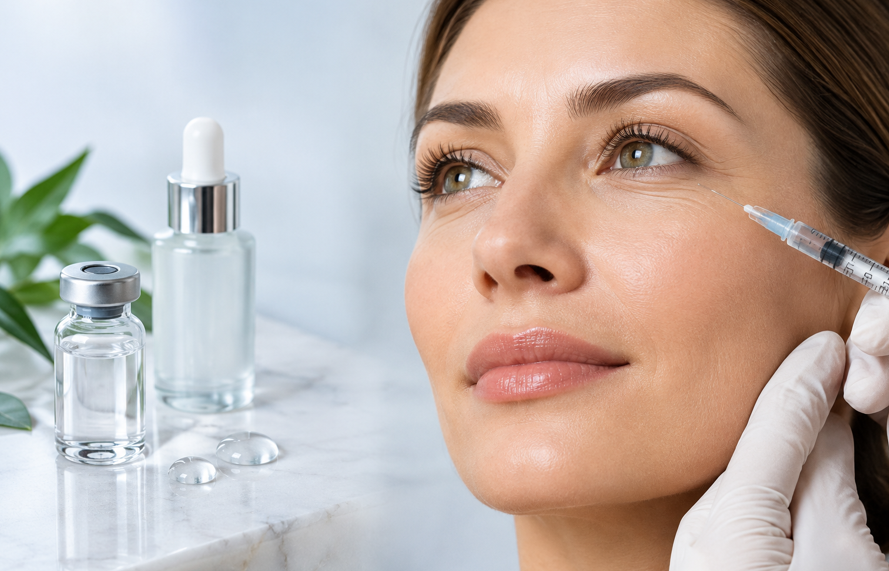
What sets HA injections apart is its capability to bypass the epidermal shield of your skin. Volume loss usually takes place into the deep dermal or subcutaneous layers. When you go for HA injections, the gel is directly deposited into these areas.
The injections are delivered via micro-needles or blunt-tipped cannulas. While pushing sunken tissue back up, the injections soften deep shadow folds from within.
Liquid hyaluronic acid breaks down within 24 to 48 hours because of a naturally occurring enzyme called hyaluronidase. As serums use non-cross-linked HA, their hydrating effect lasts until you wash off the product.
Chemically cross-linked HA polymers are present in hyaluronic acid injection (injection acide hyaluronique). Here, individual HA chains are linked with a stable 3D gel matrix and that results in immediate enzymatic breakdown. Hence, dermal fillers maintain their shape, lift, and volume for 6 to 18 months and that depends on the specific product formulation.
Let’s see how serums and injections differ.
| Feature | HA serums | HA injections |
| Goal | Hydrating the skin surface and maintaining the skin barrier | Restoring structural volume and deep crease lifting |
| Layer of action | Outer epidermis | Deep dermis |
| Mechanism | Binds water to surface cells | Physically lifts and fills hollowed tissue |
| Result duration | 12 to 24 hours | 6 to 18 months |
| Best application | Surface dullness, rough texture, fine dehydration lines, etc. | Nasolabial folds, marionette lines, hollow temples/cheeks, etc. |
Table: HA serums vs HA injections
Relying on a combination of HA serums and Hyaluronic acid injections for wrinkles offers the best possible results rather than depending only on HA injections. While dermal fillers are responsible for restoring lost contours, lifting deep folds, and rebuilding facial symmetry, HA serums keep your skin’s surface supple, resilient, and hydrated. You must pair this combination with daily broad-spectrum sunscreen and a retinoid. This ensures that both the skin above your facial framework and the tissue beneath it look healthy and fresh.
Hyaluronic acid injections are better than HA serums in treating deep wrinkles because they easily bypass the skin’s epidermal shield. Combining both of them ensures double benefits as both the upper and inner layers of your skin look youthful.
See also: Why the Herman Miller Mirra office chair suits hybrid workers who split time between desks
Find a specialized clinic near you that offers hyaluronic acid injections. Consult with them and get the treatment done. Say goodbye to deep wrinkles.