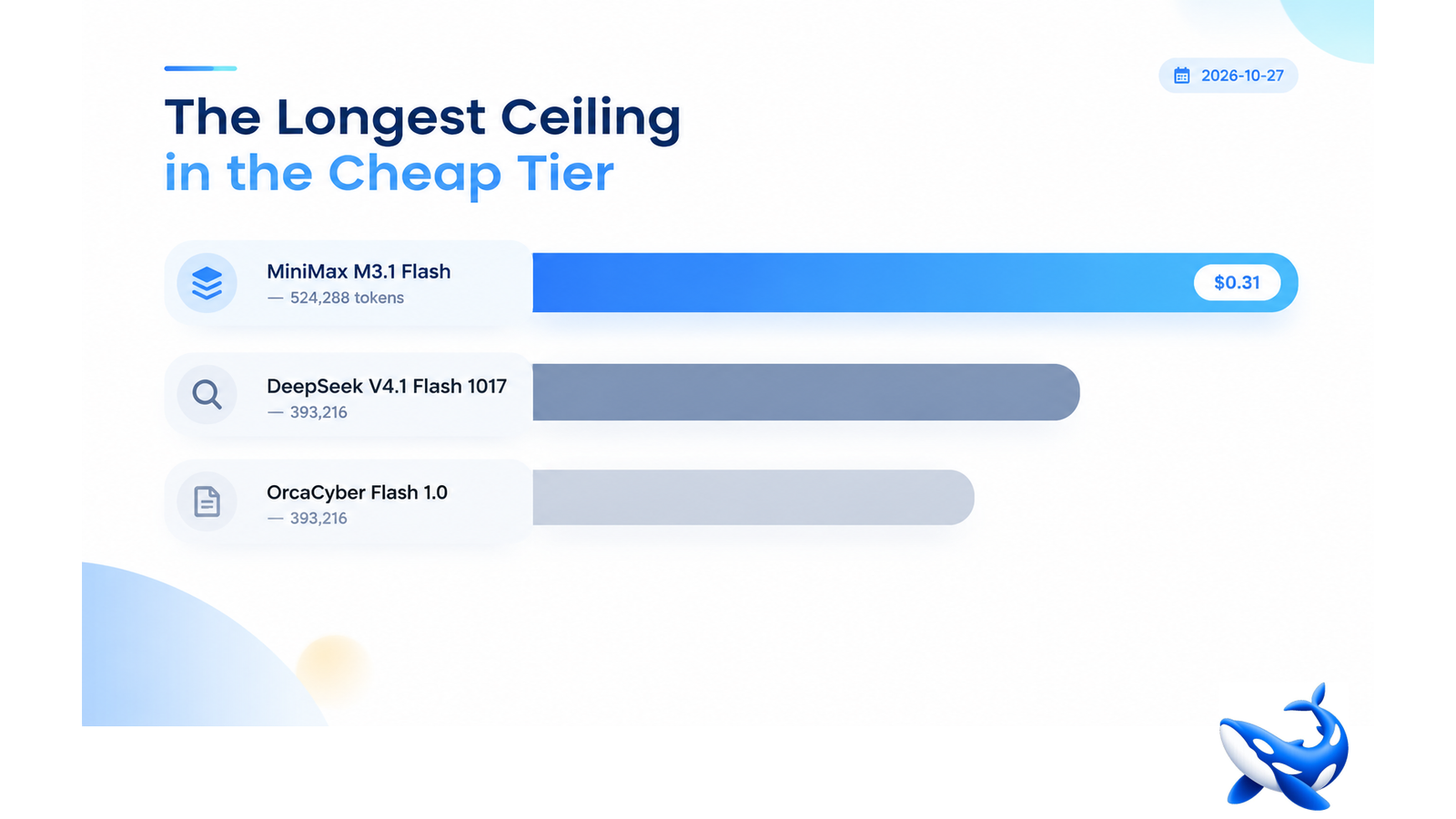

Through OrcaRouter the MiniMax M3.1 Flash card carries the largest output ceiling among the cheap models on our catalogue: 524,288 tokens in a single response, at $0.60 per million output — which means a fully maxed answer costs thirty-one cents [OURS]. That is 131,072 tokens more room than DeepSeek V4.1 Flash 1017 offers, for 7.9 cents more per maxed request.
Ceiling is the spec nobody shops on and everybody hits.
The envelope
| Property | Value |
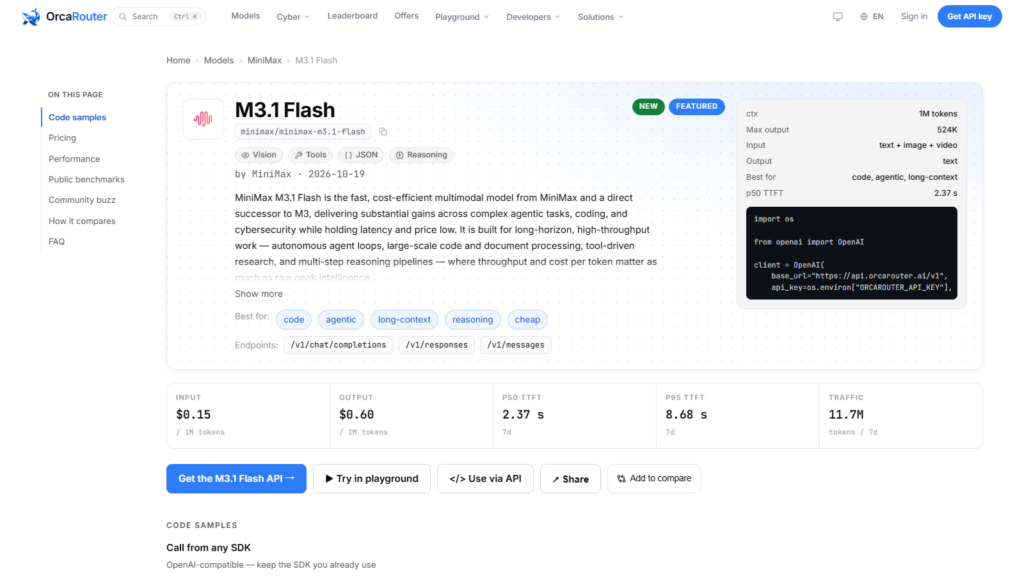
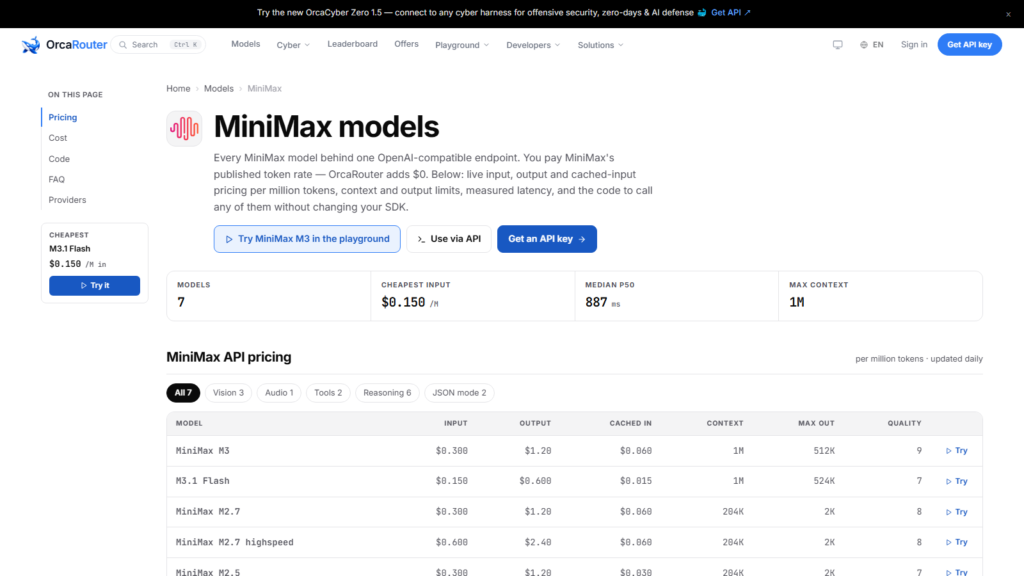
| Input / output per million | $0.15 / $0.60 |
| Cache read per million | $0.015 |
| Context window | 1,048,576 |
| Output ceiling | 524,288 |
| Input modalities | text, image, video |
| Reasoning | always on, effort low → max |
| p50 first token (7d) | 1,735 ms |
| Output throughput (7d) | 94.0 tok/s |
Two details are worth pulling out.
Reasoning is always on, with selectable effort across five levels. There is no non-thinking mode: every request pays some reasoning cost, and the effort setting is how you control it. That is a different contract from the cards that let you disable reasoning entirely.
Video input is in, alongside text and images. That is unusual at this price point and matches the model’s positioning as an agentic, tool-driving model.
See also: How Animal Clinics Improve Quality Of Life For Pets With Illnesses
Cost at the ceiling, and cost in the middle
A maxed response costs 524,288 × $0.60 / 1,000,000 = $0.3146 [OURS]. The comparison card at the same headline rate costs $0.2359 for its smaller ceiling.
But almost nobody maxes a ceiling. Price the middle:
• A 10,000-token answer: $0.006
• A 50,000-token report: $0.030
• A 150,000-token artifact: $0.090
At these sizes the card is cheap in absolute terms and the ceiling is irrelevant. The ceiling matters in the specific case where you asked for something long and got a truncation — which is a failure mode, not a cost.
What happens when you do hit the ceiling
A ceiling is only interesting if you can reach it, and reaching it is usually an accident.
Three ways a request exceeds the output limit:
Reasoning that never terminates. A model told to think at maximum effort can spend the entire budget reasoning and return nothing useful. This card has reasoning always on, which makes the failure mode more likely than on a card where you can disable it.
Instruction loops. A prompt that says “continue until complete” against a task with no clear completion condition will run to the limit and stop mid-sentence.
Genuinely long artifacts. A full specification, a whole-document rewrite, an annotated diff. These are the legitimate cases the ceiling exists for.
The mitigation for the first two is a maximum-token setting and a completion check, not a bigger ceiling. The mitigation for the third is the ceiling itself.
When a response does truncate, the recovery path matters. Two options:
Continue with the tail in context. Send the partial output back with an instruction to continue, and accept that the seam is visible. Cheap, and usually good enough for prose.
Restart with a tighter scope. If the artifact was going to run to 200,000 tokens, it probably had several sections; asking for them separately and assembling them produces a better document than continuing one long stream.
Neither is free. Both are cheaper than discovering at 3 a.m. that an overnight job produced four hundred thousand tokens of a document that needed six hundred thousand.
Cache is the weaker line
At $0.015 per million, cache reads are 10% of the input rate — a 10× discount [OURS]. Compare that with DeepSeek’s two percent, a 50× discount. On a cache-heavy agent loop the difference compounds.
A million-token prefix at a ninety percent hit rate:
• MiniMax M3.1 Flash: 0.1 × $0.15 + 0.9 × $0.015 = $0.0285 per million
• DeepSeek V4.1 Flash 1017: 0.1 × $0.15 + 0.9 × $0.003 = $0.0177 per million
A 1.6× gap that does not exist on the headline rate [OURS]. If your architecture repeats a large system prompt on every call — which most agent loops do — that is the number that lands on the invoice.
Throughput sets the practical ceiling
94.0 tokens per second measured over the seven days ending 2026-10-26 [OURS]. Filling 524,288 tokens at that rate takes about ninety-three minutes.
That changes how the ceiling should be read. A half-million-token response is not an interactive artifact; it is an overnight job. If your client has a ten-minute timeout — a common default — you will never see the top half of this card’s output range, and the ceiling is theoretical.
At smaller sizes the arithmetic is friendlier: a 10,000-token answer is under two minutes of generation, and the 1,735 ms median first token makes the card feel responsive.
Where the ceiling actually earns its keep
Three cases where the extra 131,072 tokens over the DeepSeek card is the reason to pick this one:
Long-form generation in one pass. A complete technical specification with examples, or an extended refactor proposal, can exceed 400,000 tokens. Two calls with a handoff is not the same artifact and rarely reads like one.
Transcript and document rewriting. Rewriting a long document in full, rather than summarizing it, needs output room proportional to the input.
Multi-step plans with embedded code. A plan that includes its own code blocks, test cases and rollback steps inflates quickly.
In each case the alternative is stitching, and stitching is where quality goes to die.
Who this is for
Agent builders first. The card’s positioning is long-horizon, high-throughput work — autonomous loops, large-scale code and document processing, tool-driven research — and the always-on reasoning with selectable effort is designed for that. Video input makes it usable for screenshot-and-recording-driven agent work.
Long-artifact generators second. If your product’s output is a long document rather than a chat reply, the ceiling is the spec that matters and this card has the largest one in the price band.
Everyone else should look at the cheaper cache and faster throughput of the DeepSeek card, and treat the ceiling as a tiebreaker they will never exercise.
The takeaway
524,288 output tokens at $0.60 per million is the largest writing room in the cheap tier, and a maxed response costs thirty-one cents. At ordinary sizes the card costs fractions of a cent and the ceiling never binds.
The two things that will decide it in practice are not the ceiling: a cache discount that is five times weaker than the cheapest peer, and a throughput that turns a maxed request into a ninety-minute job.
Sourcing note: pricing, context, output ceiling, modalities and reasoning settings are from the OrcaRouter model page, checked 2026-10-27 [OURS]. Latency, throughput and traffic are OrcaRouter production telemetry for the seven days ending 2026-10-26 [OURS]. Costs are arithmetic on the published rates. Benchmark figures are not used in this article; they appear in the companion piece on this card’s evaluation profile.